Intellectual Property

Intellectual property is at the center of U.S. biotech leadership. Strong, predictable, and enforceable IP protections allow companies to turn scientific discoveries into new treatments while supporting American economic growth, national security, and global competitiveness.

This is especially important for small and emerging biotechnology companies, many of which do not yet have products on the market. Their intellectual property may be their most important asset, providing the foundation they need to attract investment, form partnerships, and advance promising science.

Policy & Advocacy Priorities

Protect the Foundation of Biotech Innovation

Biotechnology product development can take more than a decade, require billions of dollars in investment, and carry a high risk of failure. Patents, trade secrets, and regulatory data protections provide the certainty innovators and investors need to undertake that work.

Strengthen U.S. Competitiveness

America’s biotechnology leadership depends on protecting discoveries at home and defending U.S. intellectual property abroad. BIO supports policies that strengthen global IP enforcement, protect trade secrets, address foreign IP theft, and preserve America’s ability to compete in strategically important technologies.

Preserve Reliable and Enforceable Patent Rights

BIO supports a patent system that is efficient, predictable, objective, and accessible to companies of every size. This includes restoring clarity around patent eligibility, preventing repeated and abusive patent challenges, and ensuring innovators have meaningful remedies when their rights are infringed.

Support Investment and Partnership

Strong IP protections make early-stage biotechnology investment and collaboration possible. They allow startups, universities, investors, and larger companies to share knowledge and resources while protecting the discoveries that make those partnerships valuable.

BIO Economic Input
Powering Biotech's Golden Age

Keeping America Competitive
Strong patents, and an efficient, predictable, and objective patent system, are critical to ensuring that America continues to leads the world in innovation, providing the United States with a global competitive advantage and spurring economic growth and the creation of high-paying jobs here at home.

Creating Breakthroughs
Strong, reliable IP protections allow startups to turn breakthrough science into lifesaving treatments — which is no easy feat. Roughly nine in 10 medicines ultimately fail in clinical trials. Without IP, the financial risks of drug development would be insurmountable.

Putting U.S. Patients First
A strong patent system ensures that U.S. patients continue to have priority access to first-in-class treatments — as well as the best and newest formulations of existing medicines. On average, new drugs are launched in the U.S. a full year before they hit other major markets like Germany and Canada.

The Lifeblood of U.S. Innovation Leadership

Safeguarding National Security


A robust, predictable IP system fuels the drug development cycle — protecting discoveries, incentivizing risk-taking, and driving the next generation of breakthroughs. By safeguarding IP, we safeguard America's global leadership, ensuring we'll continue to out-innovate China. Over the past decade, China has increased its biopharma R&D spending 400-fold.

Spurring Capital Formation


For biotech startups, IP is often the only asset that attracts the investment needed to fund early-stage innovation. Weakening IP protections chokes off this critical funding pipeline — and advantages foreign competitors. "Biotech firms with robust patent portfolios attract investment 4-5 times faster than those without strategic IP protection," according to global industry data.

Strengthening Economic Growth


IP protections underpin the biotech sector’s ability to operate and to fuel economic growth, offer high-paying jobs, and revitalize local communities. The U.S. bioscience industry supports over 10 million jobs and $3 trillion in total economic output.

IP and the "Virtuous Circle" of Innovation
 

Advancing newer and better medicines, therapeutics, and vaccines is a collective effort that involves an entire ecosystem, not just one person or company. This virtuous circle of innovation often begins with a patient or family expressing a need, and is followed by researchers responding with innovative ideas. BIO's role is to protect, advance, and enlarge this innovation ecosystem.

"The role of BIO is going to be to make sure that that entire innovation ecosystem, that virtuous circle, is protected and advanced.”
- BIO President & CEO John F. Crowley

Placeholder Image
Advocacy Materials
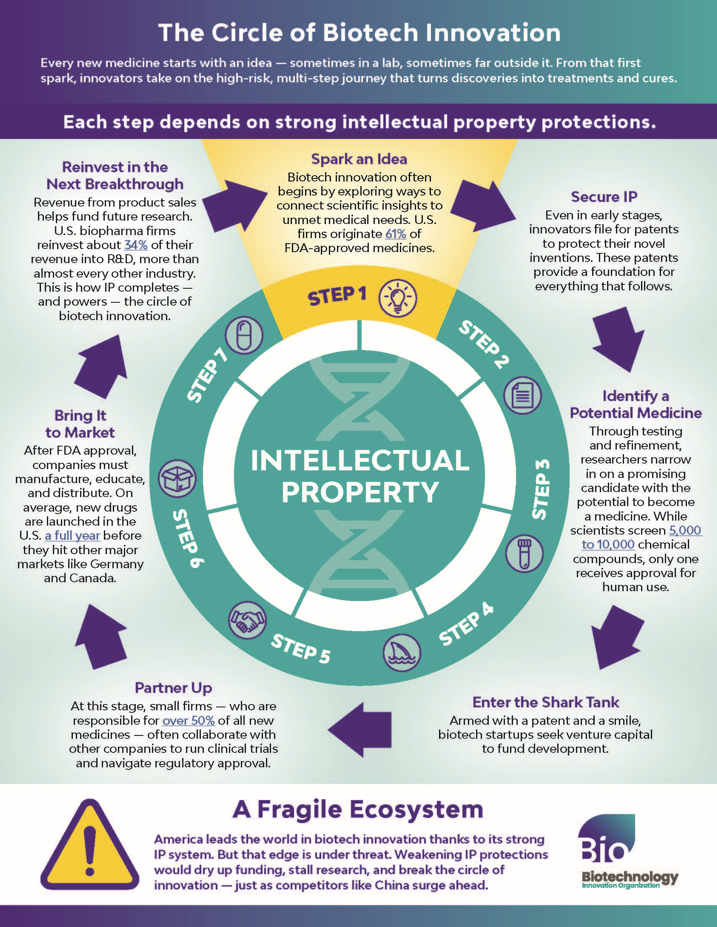
The circle of biotech

Each Step Depends on Strong IP Protections

Every new medicine begins with an idea. BIO’s Circle of Biotech Innovation follows the journey from scientific discovery and IP protection through investment, development, partnership, approval, and reinvestment in the next generation of breakthroughs.

Step 1 - Spark an Idea
Biotech innovation often begins by exploring ways to connect scientific insights to unmet medical needs. U.S. firms originate 61% of FDA-approved medicines.

Step 2 - Secure IP
Even in early stages, innovators file for patents to protect their novel inventions. These patents provide a foundation for everything that follows.

Step 3 - Identify a Potential Medicine
Through testing and refinement, researchers narrow in on a promising candidate with the potential to become a medicine. While scientists screen 5,000 to 10,000 chemical compounds, only one receives approval for human use.

Step 4 - Enter the Shark Tank
Armed with a patent and a smile, biotech startups seek venture capital to fund development.

Step 5 - Partner Up
At this stage, small firms — who are responsible for over 50% of all new medicines — often collaborate with other companies to run clinical trials and navigate regulatory approval.

Step 6 - Bring It to Market
After FDA approval, companies must manufacture, educate, and distribute. On average, new drugs are launched in the U.S. a full year before they hit other major markets like Germany and Canada.

Step 7 - Reinvest in the Next Breakthrough
Revenue from product sales helps fund future research. U.S. biopharma firms reinvest about 34% of their revenue into R&D, more than almost every other industry. This is how IP completes — and powers — the circle of biotech innovation.