|
|
|
BIO launches Fight of Our Lives campaign. Plus, Kennedy visits the Hill. (799 words, 3 minutes, 12 seconds)
|
|
|
|
BIO begins ‘Fight of Our Lives,’ urging support for biotech progress |
|
|
BIO last week launched the “Fight of Our Lives,” a campaign sharing stories of the people who tackle health challenges every day and underscoring the urgency of their fight.
Why it matters: Over the past 50 years, American biotechnology has delivered extraordinary breakthroughs—preventing illness, improving treatment, and advancing therapies once thought impossible. But that momentum cannot be taken for granted.
The challenge: Nearly 200 million in the U.S. live with at least one chronic condition, more than 30 million are affected by rare conditions, and cancer prevalence is projected to exceed 22 million by 2035. Millions are counting on the next generation of American innovation.
The fighters: “Fight of Our Lives” brings the urgency of that challenge into focus—elevating the patients, families, caregivers, researchers, and entrepreneurs driving the progress and reinforcing what it will take to sustain innovation, strengthen economic leadership, and deliver the next generation of breakthroughs.
The campaign kicked offat an event hosted by Axios, featuring: BIO President & CEO John F. Crowley, Rep. Diana DeGette (D-CO), Flagship Pioneering CEO Noubar Afeyan, and Mark Frasier, PhD, Chief Scientist, Michael J. Fox Foundation.
Looking ahead: “Today, the U.S. biotechnology industry stands at a crossroads,” said Crowley. "Will we continue to lead the world in developing life-saving biotech advancements, or risk ceding that leadership to global competitors? The Fight of Our Lives recognizes what our industry has already delivered, and what is possible over the next 50 years with smart policies, sustained investment, and continued American leadership.”
Read more on Bio.News.
See the Fight of Our Lives campaign website.
Read about the launch event.
|
|
|
|
Kennedy questioned on HHS cuts during busy week in Congress |
|
|
U.S. Health and Human Services (HHS) Secretary Robert F. Kennedy Jr. defended a proposed 12% budget cut for 2027 and acknowledged the importance of measles vaccines during three House hearings last week, while Senators looked at drug costs.
“It’s possible, certainly,” vaccination would have saved two Texas children who died from measles, Kennedy responded to Rep. Linda Sánchez (D-CA) in a House Ways & Means subcommittee hearing.
China and PBMs: Rep. Darin LaHood (R-IL) and Rep. Greg Murphy (R-NC) said uncertainty at the Food and Drug Administration (FDA) drives innovation and investments to China. Rep. Murphy called vertical integration of insurers and pharmacy benefit managers (PBMs) the “number one” reason for rising health care costs.
PBMs and fail first: In an Education & Workforce Committee hearing, Rep. James Comer (R-KY) said PBM’s vertical integration harms competition, creating a safety risk. He also criticized insurers’ “fail first” policies for blocking access to medicine.
National security concerns were raised by Reps. Jake Ellzey (R-TX) and Rep. John Moolenaar (R-MI) during a House Appropriations subcommittee hearing. Rep. Stephanie Bice (R-OK) asked how to counter China’s competition in clinical trials and how HHS cuts impact the National Institutes of Health.
PBMs, 340B, and tariffs were blamed for higher drug costs during an April 16 Senate Health, Education, Labor & Pensions (HELP) hearing. “Tariffs seem almost certain to trigger cascading supply chain disruptions and hiked prices for patients at the pharmacy counter,” said Sen. Ed Markey (D-MA).
BIO submitteda written statement to the HELP hearing on the importance of IP, noting: “Life science innovations are hard to discover and develop, and yet they are often very easy to copy, which illustrates why patent protections are so vital.”
Upcoming HHS budget hearings: See Beltway below. |
|
|
|
|
Erica Schwartz, M.D., who has led vaccine programs, was nominated by President Trump to be director of the Centers for Disease Control and Prevention (CDC). Schwartz, the Deputy Surgeon General during the first Trump Administration, served as chief medical officer for the U.S. Coast Guard, where she led disease surveillance programs and wrote policies on pandemic influenza, Ebola and other viral disease outbreaks. Her career in the Navy included acting as Chief of the Naval Immunization Clinic. Read more here.
National Health Council (NHC) discusses their 2026 Science of Engagement Summit. The NHC, which seeks to drive patient-centered health policy in the U.S., will hold their ninth science of Patient Engagement Summit in May. The event is focused on turning patient-gathered evidence into impact, empowering participating organizations to turn patient engagement into improved outcomes by strengthening how care is designed and delivered. Read more on Bio.News. |
|
|
|
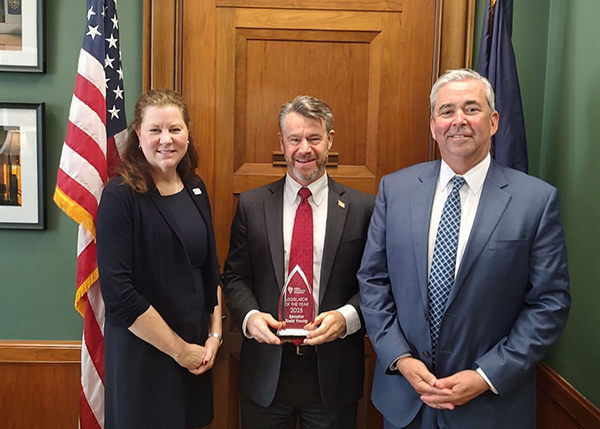
BIO organized a Capitol Hill Fly-in last week for affiliates in the Council of State Bioscience Associations (CSBA) from more than 20 states. CSBA members educated policy makers about the value of the bioscience industry and the need for a stable and predictable policy environment. They also thanked members for supporting SBIR/STTR federal seed funding reauthorization, which was signed into law last week. Above, Indiana Life Sciences Association CEO Kristin Jones and Board Chair Roger Harvey present Sen. Todd Young (R-IN), center, with their association’s Legislator of the Year Award, which this year also went to Rep. Erin Houchin (R-IN). |
|
|
|
|
|
|
|
|