|
|
|
Hearings on data protection and IP have big significance for biotech. (884 words, 3 minutes, 33 seconds)
|
|
|
|
Lawmakers warn against weakening IP for medicines in House hearing |
|
|
Lawmakers defended strong IP protections as essential to biotech innovation in a June 4 Congressional hearing that also considered the role of generics and biosimilars.
Why it matters: “Strong patent protections are why the United States has been a global leader in the discovery and development of lifesaving medications,” according to Subcommittee Ranking Member Hank Johnson (D-GA)’s remarks for the hearing before the House Judiciary Subcommittee on Courts, Intellectual Property, Artificial Intelligence, and the Internet.
Proposals to weaken IP in order to facilitate market entry of generics were discussed during the hearing, even though it was noted that 90% of the U.S. drug market is generics, while the OECD average market share for generics is 41%.
An analysis of proposals to facilitate generic market entry by the Congressional Budget Office found the impact on drug prices of each of these proposals would be 1% or less, noted witness Jamie Simpson of the Council for Innovation Promotion.
The existing balance works in allowing innovation and generics, and any weakening of IP only reduces innovation, said Rep. Deborah Ross (D-NC). Rep. Kevin Kiley (R-CA) asked: “If there was no new innovator who created the underlying drug, what would be the opportunity for a generic to come along?”
Competitors like China gain when we weaken U.S. IP observed Simpson, Rep. Russell Fry (R-SC), and others.
BIO’s view: “Our patent system serves the important function of fostering innovation and U.S. global leadership in the life sciences. This continued leadership is being challenged by our foreign competitors, especially the People’s Republic of China,” said BIO’s statement submitted for the hearing. “Further weakening patent protections would aid our foreign competitors at the expense of this strategically important sector.”
Read more on Bio.News
|
|
|
|
Congressional hearing extolls proposed federal data privacy regulation |
|
|
A June 3 hearing of the House Energy & Commerce (E&C) Subcommittee on Commerce, Manufacturing & Trade promoted the proposed SECURE Data Act to provide clarity on protecting personal data.
Why it matters: Biotechs achieve life-saving innovation with medical data, but we must protect privacy. Federal legislation replacing a patchwork of state laws would reliably safeguard consumers while facilitating innovators’ regulatory compliance. (Read more on Bio.News.)
Why a single federal law? Small businesses seeking to grow beyond their home state need consistent regulation, witnesses said. Consumers need consistent protection, lawmakers said:
- “When Americans ask if their personal data is protected, the answer depends entirely on which state they’re in.”—Subcommittee Chair Gus Bilirakis (R-FL)
- “We have 22 different state standards. That means the majority of states have zero protections for consumers when it comes to digital data privacy.”—Rep. Obernolte (R-CA)
State-inspired: Rep. John Joyce, MD (R-PA), who headed the Working Group behind the bill, said it borrows from the best state laws. E&C Chair Brett Guthrie (R-KY) called the law comparable to the Kentucky measure recently passed by a Republican legislature and signed by a Democratic governor.
Better than EU’s GDPR: Several lawmakers noted Europe’s strict data protection regulation hinders innovation:
- “We’re not competing with Europe to regulate. We’re competing with China to regulate.”—E&C Chair Guthrie (R-KY)
- “Overly protective privacy laws like Europe’s General Data Protection Regulation (GDPR), throttle innovation.”—Subcommittee Chair Gus Bilirakis (R-FL)
- “The GDPR that took effect in 2018 has seen technology startups decline in Europe,” research shows.—Rep. Russell Fry (R-SC)
BIO’s view: “The existing patchwork of various data privacy laws—across states, federal regulations, and privacy rules around the world, have created confusion and regulatory burdens,” says a letter BIO submitted for the hearing. “BIO supports the SECURE Data Act’s strong federal preemption provisions to ensure one uniform federal privacy standard.”
|
|
|
|
|
BIO PartneringTM scheduling moves at record pace ahead of BIO International Convention. A record number of meetings were accepted in the start of scheduling last week through BIO’s patented partnering system, per Mackensie Vernetti, BIO SVP of partnering. BIO PartneringTM allows those attending the June 22-25 BIO International Convention in San Diego to prearrange meetings in one of the 2,000 meeting locations available onsite. BIO held a webinar to help attendees navigate the event and make the most of the exceptional partnering opportunities at the world’s largest gathering of the biotech industry. Watch the webinar here. |
|
|
|
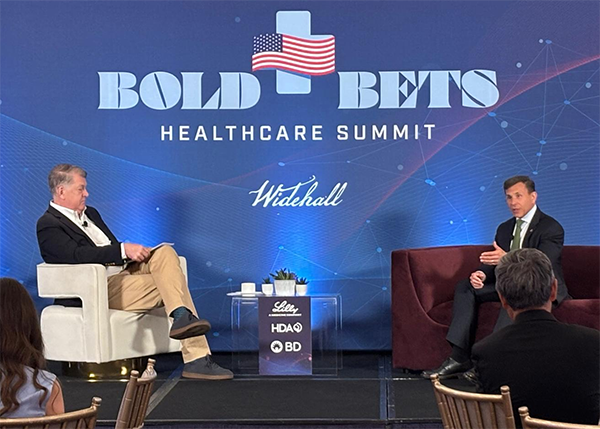
BIO President and CEO John F. Crowley was a featured speaker at the June 4 Bold Bets Healthcare Summit, which was dedicated to understanding how the U.S. can lead the world in healthcare innovation. In a conversation with host Steve Clemons, Crowley, right, underscored the importance of a healthy biotechnology ecosystem to achieving that goal. In particular, Crowley highlighted the importance of patient access to biomedical innovations and policymakers’ understanding of biotechnology, as well as the role that storytelling plays in raising awareness of how the industry works.
|
|
|
|
|
|
|
|
|