|
|
|
A strong biotech sector is important for innovation, say voters—and national security, says BIO's CEO. (909 words, 3 minutes, 39 seconds)
|
|
|
|
BIO poll: Voters want strong biotech, checks on insurance costs and PBMs |
|
|
More than 80% of American voters want strong biotech that ensures access to new medicines—and reforms to lower patient costs by targeting middlemen, insurers, and the 340B program—a BIO poll shows.
Insurance tops healthcare cost concerns, finds the national survey of 1,000 registered voters conducted Dec. 26-31 by KAConsulting on behalf of BIO. Insurance is the biggest monthly expense for 21% of respondents, trailing only housing (43%) and groceries (35%).
A strong biotech sector that can continue providing the latest treatments is supported by nine of ten voters across party lines.
Specific findings of the poll showed bipartisan agreement: - 88% support passing pharmacy benefit manager (PBM) and insurer rebates and discounts directly to consumers.
- 88% support reducing insurance co-pays to lower out-of-pocket costs.
- 88% support cutting waste and markups to reduce both premiums and medicine prices.
- 87% support requiring PBMs and insurers to share negotiated savings with patients at the pharmacy counter.
- 87% support reforms to increase transparency and accountability in the 340B program.
Policy implications: The poll shows voters prefer targeting insurance costs and supply chain markups rather than most favored nation (MFN) pricing. “Support for MFN proposals weaken once voters gain a better understanding of the implications to patients, American innovation, and the failure of the policy to strike at the heart of access and affordability issues,” BIO explains.
Read more on Bio.News.
See also: Simplify the System
|
|
|
|
BIO CEO reaffirms biotech is a national security priority at NSCEB gathering |
|
|
A year after a congressional commission called China’s threat to U.S. biotech leadership a national security priority, we have much to do toward safeguarding America, BIO President & CEO John F. Crowley told a Capitol Hill gathering.
Crowley’s message was echoed by Sen. Todd Young (R-IN), Rep. Chrissy Houlahan (D-PA), and Rep. Stephanie Bice (R-OK) at the March 25 reception, co-organized by BIO, With Honor, and others, to mark the first anniversary of the report from the National Security Commission on Emerging Biotechnology (NSCEB).
China targets biotech supremacy: With “a 400-fold increase in biopharma R&D spending, over the past decade,” the report warns.
“This is not a secret plan,” Crowley said last week. “They've laid out, as they did with rare earth minerals and other areas, exactly how they intend to dominate the field.”
Why it matters: America would lose access to medicines and China would gain a military advantage, the report warns. “The entire world is a better, safer, healthier, and more prosperous place when the United States, together with our allies, continues to lead in biotechnology,” Crowley said last week.
America can maintain biotech leadership. The report lays out clear steps, including a coordinated government effort and $15 billion in government support over the next five years to spur private investment.
Call to action: “There's much more that we need to do to secure the innovation ecosystem, to make sure that people here and everywhere have access to our medicines,” Crowley concluded. “That's our mission at BIO. That's why this work has been just so crucially important, because biotech dominance is national security.”
Read more on Bio.News.
|
|
|
|
|
Support for biotech—not price controls—needed in face of China’s competition, writes Brad Zakes, BIO SVP for Emerging Companies and Economic Affairs, in the Washington Times. “As a biotech leader who served as a commissioned officer in the U.S. Army, I know just how closely our national security is tied to biomedical leadership,” Zakes writes. “If the Trump administration wants to stay ahead of Beijing, then it needs to encourage biotech investment.” Instead of “ill-advised drug pricing schemes” that make America less competitive with China, “the administration could target the pharmacy benefit managers and other supply chain intermediaries that siphon off tens of billions of dollars.” Read more here.
JAMA covers implications of China’s growth in drug development. A March 26 JAMA research letter outlines the growth of innovative early stage drug development in China, and an accompanying editorial urges strengthening the U.S. system to stay competitive. “Global early-stage drug development has nearly doubled over the past decade, shifting from a system dominated by the U.S. toward a 2-hub structure centered on the U.S. and China,” says the letter. “Supporting basic and translational research will be critical to sustaining investment and innovation,” says the editorial. “The U.S. Food and Drug Administration must sustain and strengthen its scientific capacity while ensuring that regulatory decisions remain grounded in evidence and insulated from political influence.”
U.S. Chamber of Commerce report outlines full value of medical innovation. “American medical innovation is projected to deliver $167.5 trillion in societal value over a 30-year horizon, saving lives, extending lifespans, and driving economic growth,” says the Chamber in announcing its March 4 report. “For every dollar invested in medical R&D, the U.S. is seeing a 27-to-1 return.” For policymakers, it would be “penny wise and pound foolish” to constrain innovation “through restrictive foreign price controls, undermining intellectual property rights, or reduced R&D investment.” Read more here.
FDA approves Denali Therapeutics’ treatment for Hunter syndrome, a rare disease. The Food and Drug Administration (FDA) granted accelerated approval for AVLAYAH™, “the first FDA-approved biologic specifically designed to cross the blood-brain barrier and reach the whole body,” Denali announced on March 25. Hunter syndrome, a rare lysosomal disorder “affects physical and mental development by causing abnormalities in the skeleton, heart, respiratory system, brain, and other organs,” according to FDA’s announcement.
We are not prepared for the global health emergency of antimicrobial resistance (AMR), BIO EVP and Chief of Global Health Phyllis Arthur writes in The Hill. We need novel antimicrobial medicines, but “companies that try to develop new ones find it hard to break even,” says Arthur, urging “a new model for antibiotics that gives drug developers the financial assurance they need” to provide new treatments. Legislation to achieve this, the PASTEUR Act, was recently reintroduced in Congress and deserves support, she writes. Read more here.
|
|
|
|
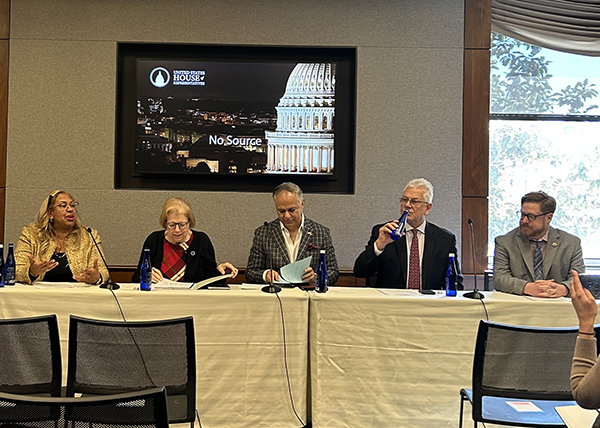
BIO EVP and Chief of Global Health Phyllis Arthur (left) moderated a panel discussion on the economic impact of influenza and the benefits of flu vaccines, organized by the Adult Vaccine Access Coalition (AVAC) on Capitol Hill last week. Arthur co-chairs AVAC, which recently released a report explaining that influenza costs America tens of billions of dollars and that improving flu vaccine rates would save billions. Panelists included business and patient representatives, a policy expert from the medical community, and the lead author of the report. Read more here. |
|
|
|
|
During testimony before the House Judiciary Committee’s Subcommittee on Courts, Intellectual Property, Artificial Intelligence last week, U.S. Patent and Trademark Office Director John Squires said his proposals for reforms to the Inter Pares Review (IPR) process for challenging patents would encourage all patent challengers to join a single action against a patent so that a series of reviews from different challengers does not unnecessarily delay an inventor’s right to enjoy a patent. “The answer isn’t serial filings, we think the answer should be gang tackling,” Squires said, according to IP Watchdog.
The House and Senate are in recess this week. |
|
|
|
|
|